Aug 20, 2026
Beginning your Mindfulness Meditation Practice
This week, Inspired Health Group's Chief Strategy and Innovation Officer, Rich Muscatello, PT, MSPT led some of our team members through a formal mindfulness meditation. Many of us, just like you may be, are new to incorporating meditation into our daily lives. We invite you to explore mindfulness meditation alongside us and see how it may help you experience greater joy and equanimity in your daily life.
What exactly is mindfulness?
Noticing our mindlessness
To understand mindfulness, perhaps it may be helpful to first describe its opposite; “mindlessness”. Mindlessness or “waking sleep”, is a mental state of unconscious, non-attention to the present moment, marked by absent or habitual & automatic perceiving, thinking (premature cognitive commitments), feeling, speaking & acting. This automaticity often is programmed subconsciously by past experiences, future projections and/or personal biases. This mental state keeps us imprisoned by repeating old patterns & limiting the range of our life experiences. Sources of mindlessness include: habit, multitasking, ignoring, stereotyping, generalizing, distraction & blindly following the cognitive path of least resistance.
Becoming familiar with the present moment
To explain mindfulness in the form we will be practicing, introduction of two words from Eastern Wisdom traditions may be helpful:
The first word is: “Gom”, the Tibetan word for meditation & translates into English as “to become familiar with”. Mindfulness is presented here as a practice that invites us “to become familiar with” what’s happening in the present moment which includes our relationship to what’s happening. In this way, we develop our capacity to be present with & clearly & skillfully “see” both what is arising in the moment, as well as perhaps our habitual reactive tendencies in sensing, thinking, feeling, speaking & acting to what’s arising, that may limit & depreciate life experience.
Cultivating our innate capacities to experience greater joy & peace
The second word is: “Bhavana” the Sanskrit word for meditation & translated into English is “to cultivate”.
Mindfulness is an opportunity to connect with and “to cultivate” our beneficial & innate capacities, in being, sensing, thinking, feeling & acting that may serve as skillful means of promoting the experience of greater joy, peace & ease for ourselves & others. Some of these innate capabilities or ways of being that we could become more familiar with & cultivate during mindfulness practice include; presence, bare attention, gentleness, steadfastness, compassion, patience, openness, gratitude, non-judgment, non-attachment, non-avoidance, non-striving, acceptance, loving kindness & equanimity.
Being of the heart-mind
Mindfulness may be considered a skillful state of being of the heart-mind, that intends to contribute to greater lasting happiness & less suffering for all living things, centers upon on the purposeful abiding in the awareness of our direct, moment-to-moment experience, with a wholesome & skillful attitude. The roots of mindfulness may be found in many wisdom traditions & although not limited to just a formal sitting meditation practice, it is probably most frequently associated with that.
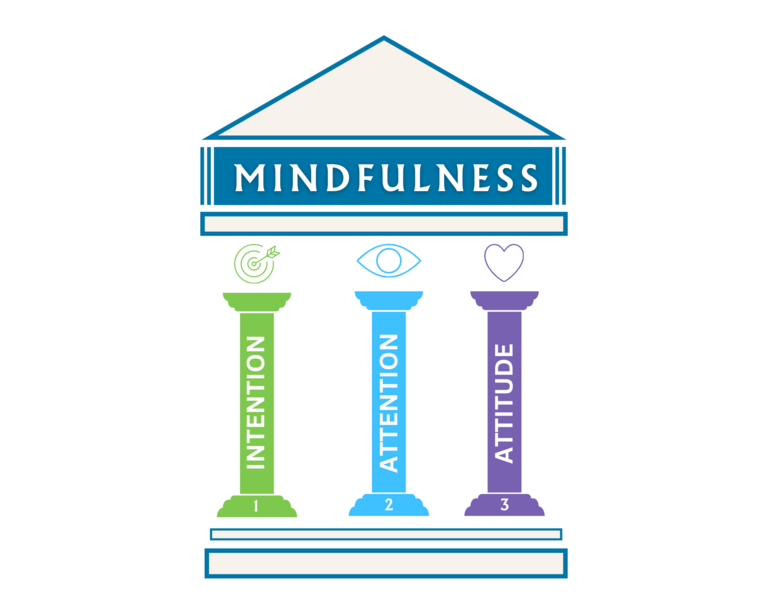
The 3 Pillars of Mindfulness
The fundamental and interwoven pillars of mindfulness are Intention, Attention & Attitude.
- Intention: What is the purpose & aspiration to being mindful? E.g.: Waking Up? To reduce mindlessness? To exercise your curiosity? To reduce thought habits?
- Attention: Multi-sensory, focused on the present moment, persistent, unbiased and simply observational and free from thinking commentary
- Attitude: to abide in; Curiosity, Nonjudgment, Openness, Steadfastness, Patience, Gentleness, Compassion, Acceptance, Non-striving, Non-attachment, Non-avoidance, Loving Kindness, Gratitude, Fearlessness and Equanimity
So then, what exactly is formal mindfulness meditation?
To "wake up"
Our mindfulness meditation may briefly be described as, “intentionally and curiously guiding our bare attention to the direct experience of the present moment, while abiding in a skillful and wholesome attitude, with the intention to ‘Wake Up’.”
Skillful shift in our relationship to what is occurring
Although Mindfulness cannot “change” the events that occur in our lives, it certainly may contribute to a skillful shift in our relationship to what is occurring, which often results in what feels to be less dissatisfaction, greater unconditional happiness & equanimity with “what is”. Applying mindfulness outside of our formal sitting practice otherwise referred to as “informal practice”, is a vehicle to greater insight to our everyday ordinary experiences while uncovering the depth, texture and richness of that we may ordinarily autopilot or mindlessly “sleepwalk” through.
How to start a mindfulness formal meditation
Although many different nuances & methods of mindfulness meditation practice exist, central to most is the notion of; intentionally directing & re-directing our bare attention to some aspect or feature of our internal landscape in the present moment without commentary including judgment. To begin, we are invited to practice with mindfulness of the breath.
- Assume an upright yet non-rigid, sitting posture that reflects wakefulness, dignity & confidence. Whether you are sitting on a chair or on the floor, perhaps you could do so without supporting the back.
- If comfortable for you, consider allowing the eyes to come to a close. If the eyes are to be open, perhaps allow the gaze to be “soft” & focused on a spot on the floor a few feet in front of you.
- You are invited to gently guide your attention to some aspect of the physical sensations of the un-manipulated in-breath and/or out-breath.
- Our intention is to directly experience the “feeling” or physical sensations of our breathing.
- If and when attention drifts away from the breath, we are invited to precisely & non-judgmentally recognize it has done so, note where it has wandered to & gently escort the attention back to the breath.
- With gentleness, patience & non-judgment, repeat the previous step, moment to moment, again & again & again…
- Feel free to allow any thoughts, emotions or other physical sensations that spontaneously arise & attract your attention, to simply pass through your field of awareness without trying to hurry, repress or stop them nor “cogitate” about or comment on them & simply return to the breath.
- Remember you will only harvest from the seeds that you sow & nurture during your practice. In other words, remember the capabilities we are invited to cultivate (wakefulness, gentleness, non-judgment, patience, etc.).
How to start a mindfulness informal meditation
Bringing the same Intention, Attention & Attitude that we engage with in our formal meditation to everyday undertakings such as walking, brushing your teeth, taking a flight of stairs, taking a shower, eating dinner, etc transforms that activity from an “auto-pilot”, habituated and mindless experience to a mindfulness practice moment and experience. So, you are invited.
“In any given moment, we are either practicing mindfulness or, de facto, we are practicing mindlessness. When framed in this way, we might want to take more responsibility for how we meet the world, inwardly & outwardly in any & every moment.” - Jon Kabat-Zinn
“The treasure that we seek requires no lengthy expedition, no expensive equipment, no superior aptitude or special company. All we lack is a willingness to imagine that we already have everything that we need. The only thing missing is our consent to be where we are.” - Barbara Brown Tylor